
The World’s Biggest Exporters
From “Cheap Made in China” to High-Tech China: Why Global Buyers Still Start Their Sourcing Journey Here
CHINA MARKET TRENDSQUALITY & LOGISTICS
From “Cheap Made in China” to High-Tech China: Why Global Buyers Still Start Their Sourcing Journey Here
For years, “Made in China” was often misunderstood as a label for cheap, low-quality products.
That idea is outdated.
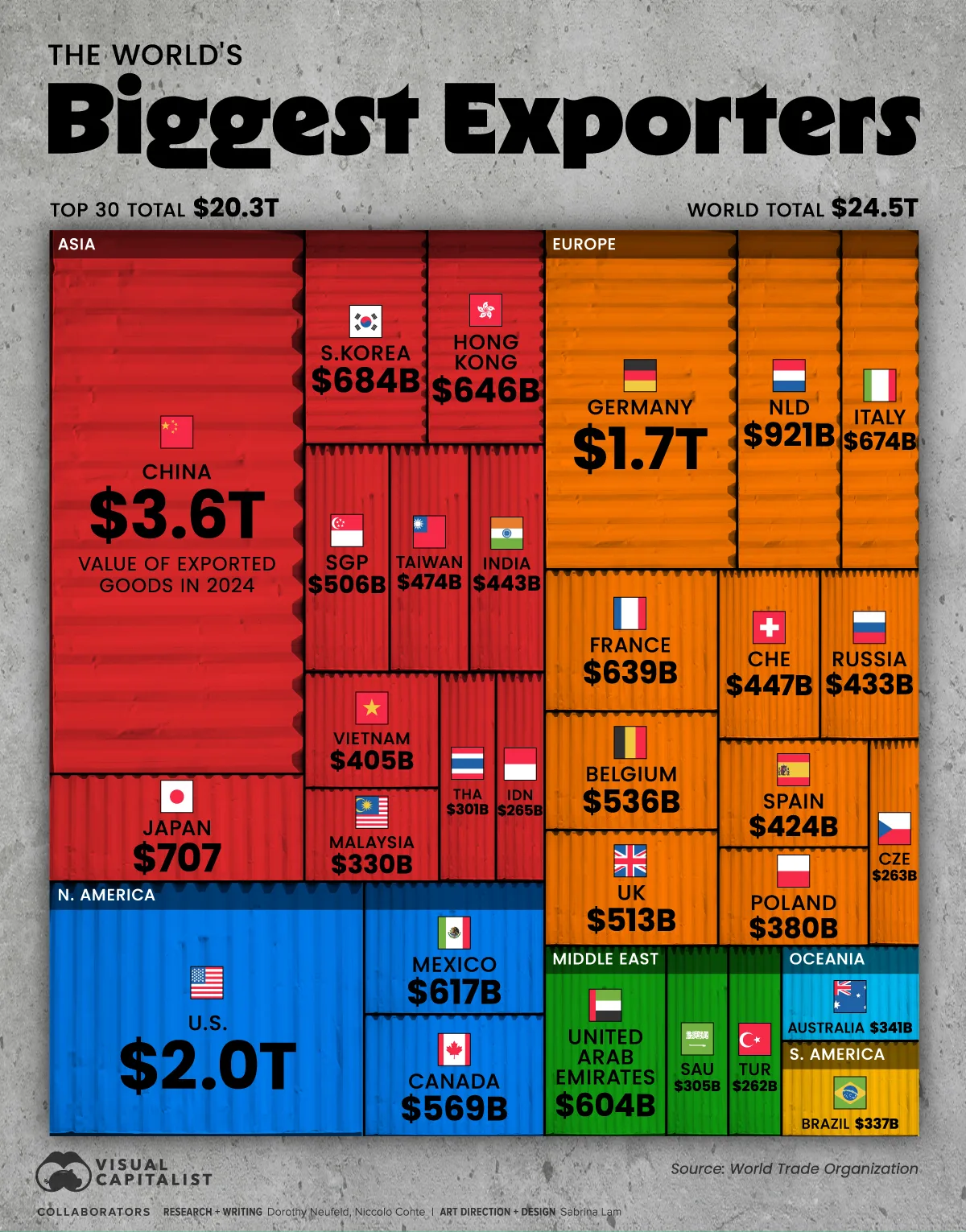
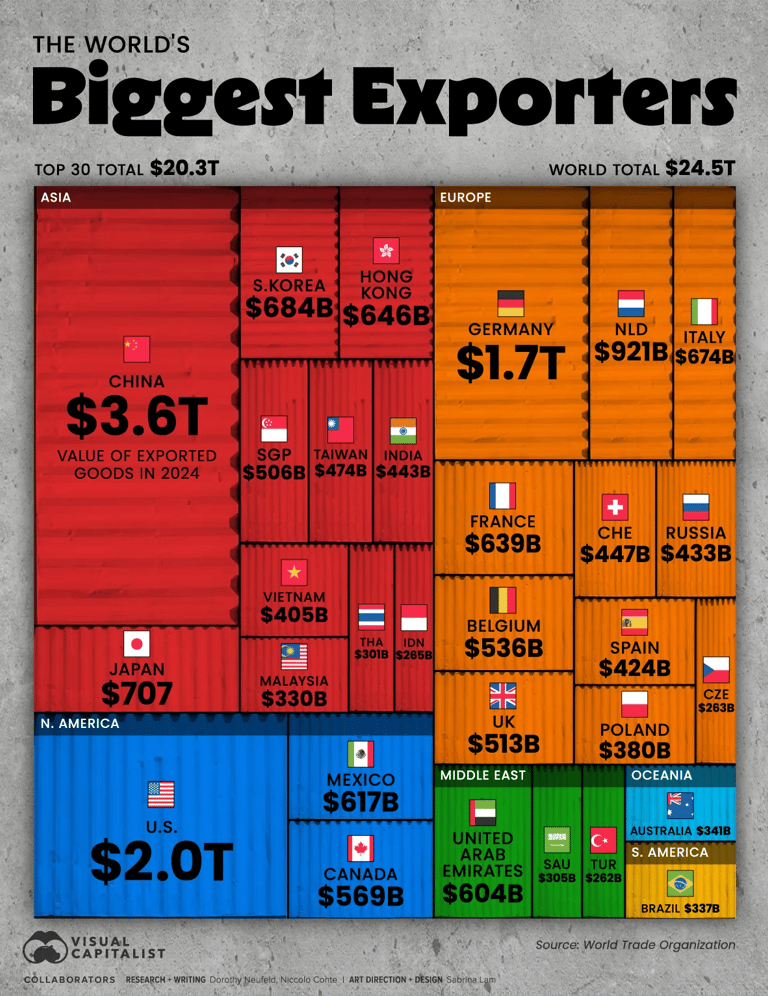
Today, China is not only the world’s largest exporter of goods. It is also one of the strongest manufacturing ecosystems for electronics, machinery, packaging, consumer products, components, industrial goods, and increasingly advanced technology products. In 2024, China exported about US$3.6 trillion in goods, remaining the world’s largest exporter and accounting for around 14.6% of global merchandise exports, according to WTO-based data reported by Visual Capitalist.
That number matters because sourcing is not only about price. It is about access.
Access to suppliers.
Access to materials.
Access to production capacity.
Access to samples, packaging, tooling, customization, and scalable manufacturing.
And this is why China remains one of the first places global buyers look when they want to turn a product idea into a real business
The Map Tells the Story: China Is Still the World’s Export Powerhouse
The latest exporter maps show a clear picture: China leads global goods exports by a wide margin.
In 2024, China’s goods exports reached about US$3.6 trillion, ahead of the United States at around US$2.1 trillion and Germany at around US$1.7 trillion, based on WTO figures visualized by Visual Capitalist.
This does not mean every product should automatically be sourced from China. But it does prove one thing clearly:
China is not just another sourcing destination. It is the center of the global manufacturing conversation.
For entrepreneurs, importers, online sellers, and growing brands, that scale creates real advantages:
China has more supplier options across more product categories. It has mature export experience. It has deep component and material supply chains. It also has factories used to working with international buyers, packaging requirements, compliance documents, freight forwarders, and product customization.
That combination is difficult to replicate.
“Made in China” Is No Longer Just About Low Price
The old idea was simple: China made cheap products.
The new reality is different: China manufactures across many quality levels, from basic entry-level goods to advanced electronics, precision components, electric vehicles, industrial equipment, smart devices, and high-value exports.
One strong proof is high-tech exports. WIPO reported that China’s high-tech exports reached about US$825.2 billion in 2024, making China the leading high-tech exporter “by far” in its analysis.
China is also moving upward in innovation. In the Global Innovation Index 2025, WIPO ranked China 10th out of 139 economies, placing it in the global top 10 for the first time. WIPO also reported that China leads globally in “Knowledge and technology outputs.”
This is important for buyers because sourcing from China is no longer only about finding the lowest unit price. It is increasingly about finding the right manufacturing level for the right product goal.
A buyer can look for low-cost basic goods, but they can also look for improved materials, better finishing, stronger packaging, private-label customization, smarter components, better tooling, and more professional export preparation.
The difference is not “China good” or “China bad.”
The real difference is this:
Do you know how to choose the right supplier?
The Biggest Sourcing Mistake: Thinking Alibaba Is the Whole Supply Chain
Many new buyers start with a marketplace search. That is normal.
But finding a supplier online is only the first step.
A product listing does not tell you everything. It may not show the real factory. It may not show the exact material. It may not explain packaging strength, certification limits, production risks, sample differences, payment terms, or whether the supplier truly understands your market.
This is where many sourcing projects go wrong.
The problem is not always that the supplier is bad. Sometimes the problem is unclear communication, missing specifications, rushed decisions, poor sample review, weak quality checks, or unrealistic expectations.
That is why sourcing from China should not be treated as a simple “find product, pay supplier, receive shipment” process.
It is a step-by-step business process.
You need to clarify what you want.
Compare suppliers properly.
Check samples carefully.
Confirm materials and packaging.
Follow production.
Coordinate quality checks.
Prepare shipping information.
And make sure the final product matches what you actually ordered.
This is also the core reason Silkora exists: to help entrepreneurs and growing businesses source from China with clearer supplier options, smoother communication, sample follow-up, production coordination, quality-check support, and China-side guidance.
Why China Is Still the Best Starting Point for Many Sourcing Projects
China is not the only sourcing country. Vietnam, India, Mexico, Türkiye, Poland, Indonesia, Thailand, and many others are important manufacturing markets.
But for many product categories, China remains the strongest starting point because of five practical advantages.
1. Supplier Depth
China has a huge number of suppliers across consumer products, electronics, packaging, machinery, home goods, accessories, industrial parts, and custom products. More supplier options usually means more room to compare price, quality, materials, MOQ, lead time, and customization.
2. Manufacturing Ecosystem
In China, one product often connects to a full ecosystem: raw materials, components, tooling, packaging, printing, finishing, inspection, and logistics. That ecosystem can make development faster and more flexible.
3. Export Experience
China has decades of experience exporting to global markets. The scale of China’s exports shows that many Chinese suppliers are already familiar with international documentation, packaging requirements, shipping coordination, and overseas buyer expectations. China’s 2024 export position as the world’s largest goods exporter supports this point.
4. Quality Range
China does not produce only one quality level. Buyers can find very low-cost products, but also mid-range, premium, technical, and high-specification products. The challenge is knowing how to communicate the quality target and how to verify it before shipment.
5. Technology Growth
China’s role in high-tech exports and innovation shows that the country is no longer only a low-cost manufacturing base. WIPO’s 2024 high-tech export data and 2025 innovation ranking both support the idea that China is becoming more advanced, not less relevant.
The Real Opportunity: Source Smarter, Not Cheaper
The buyers who win with China sourcing are not always the ones who find the cheapest supplier.
They are the ones who source smarter.
They know what information to prepare.
They compare suppliers carefully.
They check whether a low price hides weaker materials or packaging.
They confirm samples before mass production.
They follow up during production.
They check quality before shipping.
That is the difference between buying a product and building a reliable sourcing process.
A cheaper quote can look attractive at the beginning, but if the final product arrives with wrong materials, weak packaging, poor finishing, wrong labels, or unexpected defects, the “cheap” option becomes expensive very quickly.
Good sourcing is not about chasing the lowest price.
Good sourcing is about finding the right balance between price, quality, supplier reliability, timing, communication, and risk control.
Where Silkora Supply Fits In
For many entrepreneurs and growing businesses, the hardest part is not wanting to source from China.
The hardest part is knowing where to begin.
Silkora Supply was created as a China-based sourcing support partner for buyers who do not want to manage the process alone. The brand positioning is clear: Silkora helps clients find suitable Chinese suppliers, compare samples and offers, follow production, coordinate quality checks, and prepare shipments with practical China-side support.
Silkora is not here to make unrealistic promises.
Not every supplier is right.
Not every low price is safe.
Not every product idea is ready for production.
Not every project should move forward without checking the details first.
That is exactly why guidance matters.
Silkora helps buyers understand what is realistic, what information is missing, what risks need attention, and what the next step should be. This follows the brand’s recommended approach: clear communication, realistic advice, practical coordination, and no fake promises.
Final Thought: The Future of Sourcing Is Still Connected to China
The global supply chain is changing. Buyers are exploring more countries, diversifying risks, and comparing options more carefully.
But the data is clear: China remains the world’s largest goods exporter, a major high-tech export leader, and a rising innovation economy.
For buyers, this means China should not be viewed through old stereotypes.
“Made in China” today can mean basic goods.
It can mean competitive pricing.
It can mean advanced manufacturing.
It can mean high-tech exports.
It can mean scalable production.
It can mean the right supplier, if you know how to find and manage them.
The opportunity is still there.
You just need the right way to start.
Silkora Supply helps you source from China clearly, safely, and without feeling lost.
Global goods exports climbed to about $24.5T in 2024. China stayed #1 with ~$3.6T (≈14.6% share), widening the gap with the U.S. (~$2.1T) and Germany (~$1.7T). Visual Capitalist’s new treemap (sourced to WTO data) shows a resilient export hierarchy—Asia’s manufacturing base is not shrinking; it’s reorganizing and getting more sophisticated. Visual Capitalist
Fast context (2024 goods exports, top 10)
China ~$3.6T (14.6%)
U.S. ~$2.1T (8.4%)
Germany ~$1.7T
Netherlands ~$921B
Japan ~$707B
South Korea ~$684B
Italy ~$674B
Hong Kong SAR ~$646B
France ~$639B
Mexico ~$617B. Visual Capitalist
Trade didn’t die; it reorganized. WTO and UN trade updates show a recovery after 2023’s dip, with shifting routes—not a collapse—amid policy changes and Red Sea disruptions. Reuters+1
The signal behind the numbers: quality and repeatability
For many categories, manufacturing in China is now synonymous with quality—not because everything is luxury, but because process control, certifications, and logistics have become systemic advantages.
Certification depth. Independent analyses of the ISO Survey show China consistently leading the world in ISO 9001 (quality) and ISO 14001 (environment) certificates—a proxy for management systems baked into factories that export. (Note: ISO hosts the primary dataset on IAF CertSearch; public summaries for 2022 place China #1 by a wide margin.) ISO+1
Trade facilitation. UN agencies rate China’s E-Single Window and paperless customs as “fully implemented,” cutting friction between factory, forwarder, and port—useful when your booth or retail kit must hit DWTC, HKCEC, or Marina Bay Sands on fixed install days. UN Global Survey
Logistics performance. In the World Bank LPI 2023, China sits in the upper tier globally, reflecting reliable infrastructure and competence scores that matter for multi-site rollouts. Logistics Performance Index+1
High-tech spillover. The rigor that made China dominant across major steps of solar PV manufacturing (and a surge in EV exports) shows up in adjacent categories: tighter LED binning, cleaner acrylic bonding, more consistent metalwork and FRP layups for displays. Visual Capitalist
Takeaway: “Cheap = China” is an outdated mental model. The modern competitive edge is repeatability: the same look, same tolerances, same paperwork—across venues and markets.
What this means for VM leaders, designers, shopfitters & expo contractors
1) Buy specs, not slogans.
Write the finish + light outcomes you need: gloss units, texture direction, edge treatments, CRI/SDCM, beam angles, driver brand and documentation set (CE/LVD/EMC, RoHS/REACH). When factories run ISO systems, they can track and prove these. ISO
2) Engineer the logistics on day zero.
Ask for export-ready, labeled crates, QR-based install manuals, and a lighting plot that mirrors the crate map; the Single-Window environment makes the rest of the journey smoother. UN Global Survey
3) Standardize the “finish library” and reuse it.
One hero metal, one acrylic tone (back-painted), one wood family; lock edge details and shadow gaps. That’s how brands keep the camera-ready effect from Dubai to Hong Kong without re-inventing the spec every show.
4) Measure what matters.
Dwell at hero zones, guided path compliance, interaction/touch counts, and photo/UGC rates. If the numbers move, the spec is working—keep it.
The bigger picture: global exports ≠ race to the bottom
The 2024 treemap shows China at ~14.6% of world goods exports, but also highlights multi-hub Asia: Korea, Japan, ASEAN, Taiwan—all with meaningful shares. Risk management today is less about abandoning Asia and more about using its depth intelligently. Visual Capitalist
WTO forecasts point to recovery with risks: tariff escalations could shave growth in 2025, but the baseline remains re-routing, not de-globalization. Build your supplier stack accordingly. Reuters
TL;DR for retail & exhibition teams
“Made in China” now often reads as “process + paperwork + predictability.”
Quality = repeatability across finishes, lighting, packing, and compliance.
The export map is really a capability map—use it to plan rollouts, not just to argue politics.
Sources (for your first comment on LinkedIn)
Visual Capitalist (WTO-sourced) — Biggest Exporters in the World (2024, published Oct 13, 2025): breakdown to ~$24.5T and country shares. Visual Capitalist
WTO — World trade outlook & statistics (2024–2025): recovery after 2023’s dip; risks from tariff escalations. Reuters+1
UN Trade & Development (UNCTAD) — Global Trade Update 2024/2025: record trade value and composition. UN Trade and Development (UNCTAD)
ISO — ISO Survey (access via IAF CertSearch); independent 2022 summaries place China #1 for ISO 9001/14001 certificates. ISO+1
UN Trade Facilitation Survey (2025) — China’s E-Single Window and paperless trade fully implemented. UN Global Survey
World Bank LPI 2023 — logistics performance dashboards and global report. Logistics Performance Index+1
Silkora Supply Chain
Helping entrepreneurs and growing businesses source from China with trusted China-side support.
Pages
Home
How It Works
Services
About
Contact
Reach us
hello@silkorasupply.com
Zhongshan, Guangdong, China
We’ll reply with a clear next step.
© 2026 Zhongshan Silkora Supply Chain Co., Ltd. All rights reserved.
CLOSER TO THE SOURCE